
NFL UK Fanbase: 14 Million Fans and What That Means for the Betting Market
 Available in US
 Available in US
Contents
From Niche to Mainstream: The NFL’s UK Trajectory
I remember watching Super Bowl XLII in 2008 in a mate’s living room with four people, none of whom understood the rules. We drank beer, cheered at big hits, and fell asleep before half-time. Last February, I watched the Super Bowl at a 400-capacity venue in central London that sold out in nine minutes. The room knew what a third-down conversion meant. They argued about whether the play-caller should have gone for it on fourth-and-two. The NFL in the UK has changed beyond recognition, and the numbers tell that story with precision.
The NFL now has 14.3 million fans in the United Kingdom, including 4 million who classify themselves as “avid” — meaning they follow the league actively throughout the season, watch multiple games per week, and engage with NFL content year-round. That fan base makes the UK the NFL’s largest international market by a significant margin, and it translates directly into betting volume, market depth, and the range of NFL products UK bookmakers choose to offer.
See also: NFL London games betting fuelled by growing UK interest.
Fanbase by the Numbers: Avid, Casual, and Under-35
The 14.3 million figure breaks down into layers that matter for understanding the betting market. The 4 million avid fans are the engine — they watch games live, hold opinions on team form and player matchups, and are the most likely to place informed bets. The remaining 10.3 million are casual fans who engage primarily around tentpole events: the Super Bowl, London games, and playoff weekends. Casual fans are disproportionately represented in novelty prop and accumulator markets, where deep knowledge is less necessary.
The youth demographic is where the growth is most striking. Super Bowl LVIII viewership among under-35s in the UK surged by 91% year on year, and 74% of under-35s watching television at that hour were tuned into the Super Bowl. This isn’t a niche sport attracting a niche audience — among young British adults, the Super Bowl has become must-watch television that rivals Premier League and Champions League finals for cultural attention.
The UK accounts for approximately 3% of NFL fans worldwide by web search traffic, a share that has grown steadily as the league invests in international expansion. That 3% translates into a betting market that UK operators take seriously: NFL sections at major bookmakers now feature dedicated trading desks, bespoke promotional campaigns, and market depth that would have been unimaginable a decade ago.
UK Viewership Records: Super Bowl and Regular Season
Television viewership provides the hardest data on the NFL’s UK penetration, and the trajectory is unambiguously upward.
Super Bowl LVIII on Sky Sports UK drew a peak audience of 761,000 viewers — a 35% increase over the previous record. Henry Hodgson, general manager of NFL UK, described the result: “The viewership, combined with the social engagement through Super Bowl week, is a testament to the growth of the NFL in the U.K., particularly among the youth demographic that we’ve targeted this season.” That youth focus isn’t accidental — the NFL has deliberately positioned its UK marketing around the 18-34 demographic, using social media, gaming partnerships, and London game activations to build a habit of NFL viewership that converts casual interest into regular engagement.
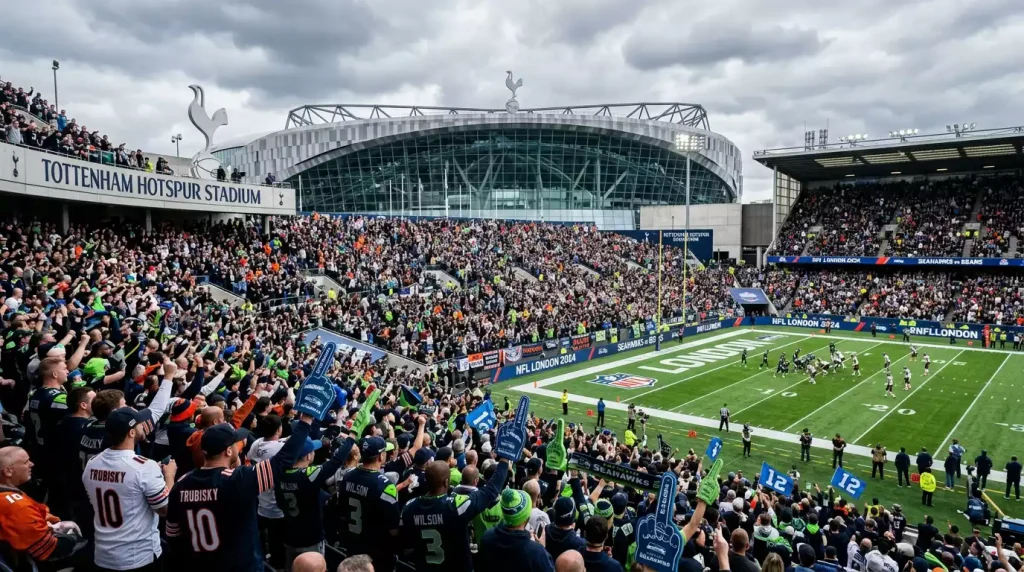
The London games represent the NFL’s most direct UK investment. Over 6 million people watched the London NFL games during the 2026 season across television and streaming platforms. These games serve a dual purpose: they give UK fans a live, in-person NFL experience (Tottenham Hotspur Stadium and Wembley both host regular fixtures), and they anchor a week of NFL media coverage on UK networks that exposes casual viewers to the sport. The betting implications are immediate — London game weeks produce the highest NFL betting volumes at UK bookmakers outside of the Super Bowl, driven by the combination of accessible kickoff times (typically 2:30pm on a Sunday) and extensive pre-match coverage.
Regular-season viewership in the US provides context for the product’s quality. The 2026 NFL regular season averaged 18.7 million viewers per game — the second-highest figure in league history. The NFL isn’t a declining product seeking new markets; it’s a peak-performing product extending its reach. That distinction matters for UK punters because it means the league’s investment in international growth is funded by domestic strength, not driven by domestic weakness.
How a Growing Fanbase Translates to Betting Volume
Fan growth and betting growth are linked, but not linearly. A 91% increase in under-35 viewership doesn’t mean a 91% increase in under-35 NFL betting. The conversion funnel from viewer to bettor passes through several stages: awareness of betting markets, understanding of bet types, creation of a bookmaker account, and actual wagering. Each stage loses a percentage of the funnel. But the funnel is widening at every stage simultaneously.
Survey data from early 2026 indicates that approximately 68% of UK gamblers expect to increase their betting activity over the coming sports calendar, with the FIFA World Cup cited as the primary driver. NFL betting benefits from this broader uplift because the sport’s UK season (September to February) fills the gap between the end of the European football season in May and the start of the domestic season in August. Punters who develop a betting habit during the World Cup or European Championship carry that habit into the NFL season if they’ve been exposed to the sport.
The 14.3 million fan base also influences market liquidity. More UK punters betting on NFL games means more money in the market, which tightens odds margins and forces bookmakers to price NFL events more competitively. Five years ago, NFL odds at UK bookmakers carried margins two or three percentage points wider than Premier League odds on the same operator. That gap has narrowed significantly, and for marquee NFL events — the Super Bowl, conference championships, and London games — the margins are now comparable to top-tier football matches.
For a closer look at how the London games specifically create unique betting angles — travel factors, neutral-crowd dynamics, and the specific edges available to UK-based punters — those game-specific opportunities are a direct product of the fan base growth documented here.
See also: betting online nfl — UK fanbase growth.
