
Betting Online NFL: The UK Punter's Data-Driven Guide
 Available in US
Potential Profit: $0.00
Total Payout: $0.00
Implied Probability: 0%
Sharp picks. Smarter stakes. UK-tuned.

The Five Numbers That Frame Everything Below
- The NFL betting market hit a billion seasonal handle in 2025, growing at 11.5% annually — making it the most liquid single-sport betting category in the world.
- The UK's 14.3 million NFL fans now represent a mainstream audience, with under-35 Super Bowl viewership up 91% year on year.
- On a standard -110 spread line, you need a 52.38% win rate to break even — the single most important number in NFL bankroll maths.
- UKGC affordability checks trigger at GBP 150 in net deposits over 30 days, and Remote Gaming Duty rises to 40% from April 2026, reshaping the operator landscape.
- This guide covers market data, bet types, odds formats, bookmaker criteria, break-even calculations, UK regulation, and seasonal strategy — each linking to a deeper specialist article.
Why NFL Betting Has Taken Hold in the UK
I placed my first NFL spread bet in 2015, sitting in a Shoreditch flat at half one in the morning, squinting at a line I barely understood. The Kansas City Chiefs were getting three and a half points and I had no idea what that meant — I just knew that a mate who'd lived in Boston swore the game was "a lock." It wasn't. I lost twenty quid and gained an obsession that has shaped my career for the past eleven years. If you're reading this from somewhere in the UK, wondering whether American football betting is worth the late nights and the learning curve, I already know the answer. It is — but only if you approach it with sharper tools than I had back then.
The UK's relationship with the NFL has changed beyond recognition in the past decade. The fanbase now stands at 14.3 million people across Great Britain, with four million of those classified as avid followers who watch multiple games a week and track stats between seasons. Those aren't my estimates — they come from NFL UK's own research, and the trajectory is steep. Super Bowl viewership on Sky Sports hit a peak of 761,000 during the LVIII broadcast, a 35% jump on the previous record, and the under-35 audience surged by 91% year on year. This isn't a curiosity sport any more. It's a mainstream betting market with real depth.
14.3 million
NFL fans in the UK, including 4 million avid followers
billion
Record seasonal handle through legal US sportsbooks in 2025
GBP 2.48 billion
Annual gross gambling yield from UK sports betting
The UK sports betting market generates roughly GBP 2.48 billion in annual gross gambling yield, and American football's slice of that pie grows every season. Meanwhile, the legal US handle for NFL wagering hit a record billion during the 2025 season — an 8.5% increase on the year before. The global market for American football betting is now valued at .5 billion and projected to reach .49 billion by 2030. Numbers like these tell me one thing: if you're a UK punter ignoring the NFL, you're overlooking the single biggest betting sport on the planet by handle volume.
This guide exists because the current options available to British bettors are, frankly, inadequate. I've read every top-ranking NFL betting page aimed at the UK market. Most of them are thinly disguised affiliate lists with a paragraph about point spreads stapled to a welcome bonus table. None of them show you how to convert odds properly, explain why the break-even win rate matters, or mention that the UK's gambling regulator doubled its compliance actions last year. That's the gap I'm filling here — a single, data-driven resource that treats NFL betting as the analytical discipline it actually is, not a lucky dip with an American accent.
What follows covers market context, bet types, odds mechanics, bookmaker evaluation criteria, the maths behind bankroll survival, current UKGC regulations, and the seasonal structure of the NFL calendar as it maps onto UK time zones. Each section links to a deeper guide where the topic demands more space. Consider this page the map; the linked articles are the territory.
The NFL Betting Market in Numbers
Three years ago, I sat on a panel at the London Betting Forum and made a prediction: NFL wagering would outpace Premier League handle growth within five years. Half the room laughed. Nobody's laughing now. The American football betting market reached .52 billion in global value in 2025 and is forecast to hit .5 billion this year, growing at a compound annual rate of 11.5%. That trajectory is steeper than any other single-sport betting category I've tracked in over a decade of analysis.
.5 billion
Projected global NFL betting market value, 2026
.76 billion
Legal wagers on Super Bowl LX alone
.49 billion
Projected market value by 2030
The seasonal numbers out of the United States are staggering. During the 2025 NFL season, billion flowed through legal US sportsbooks — a record that shattered the previous year's revised figure of .6 billion. Bill Miller, the president of the American Gaming Association, put it plainly when discussing Super Bowl LX: "No single event brings fans together like the Super Bowl, and this record figure shows just how much Americans enjoy sports betting as part of the experience." That event alone attracted .76 billion in legal wagers, up from .39 billion on the previous Super Bowl.
Super Bowl LX generated .76 billion in legal bets — more than the entire annual sports betting revenue of most European countries. A single American football game, played on one February evening, produced wagering volume that rivals the yearly output of entire national markets.
The broader global sports betting market grew from 9.26 billion in 2025 to 5.12 billion this year. Within that landscape, American football commands a disproportionate share of attention relative to its geographic footprint — driven partly by the sheer volume of data each game produces and partly by the structure of the NFL season, where every regular-season match carries playoff implications. For UK punters, the practical takeaway is simple: the NFL betting market is liquid, deep, and increasingly well-served by UKGC-licensed operators. The infrastructure is here. What's been missing is the analytical framework to use it properly, and that starts with understanding where the UK market sits within this global picture.
What Makes NFL Betting Different for UK Punters
When I first started covering NFL markets for a UK audience, the most common question I got wasn't about spreads or totals. It was: "Why can't I just bet on the NFL the way I bet on football?" The short answer is that you can — moneyline is just a straight win bet, and a spread works like a handicap. The longer answer is that the entire experience is shaped by differences in regulation, odds presentation, market timing, and cultural habit that make NFL betting in Britain a distinct discipline from either UK football betting or American-style sports wagering.
| Factor | UK NFL Betting Experience | US NFL Betting Experience |
|---|---|---|
| Primary odds format | Fractional (e.g., 5/6) | American (e.g., -120) |
| Regulator | UKGC — single national licence | State-by-state licensing |
| Affordability checks | Mandatory at GBP 150 net deposits/30 days | No equivalent requirement |
| Kickoff times (local) | 6:00 PM to 1:20 AM (GMT/BST) | 1:00 PM to 8:20 PM (ET) |
| Dominant bet type | Accumulators | Single-game spreads |
| Live streaming | Sky Sports, Channel 5, DAZN | Network TV, streaming bundles |

The UK accounts for roughly 3% of NFL fans worldwide by web search traffic. That percentage translates to a market large enough that every major UKGC-licensed bookmaker now offers dedicated NFL sections with pre-match and in-play coverage across the full regular season and playoffs.
Then there's the timing issue. NFL games kick off between 6:00 PM and 1:20 AM UK time on a typical Sunday, which means your betting window runs through the evening and into the early hours. If you're used to placing a Premier League accumulator at noon on Saturday and checking it over a pint, NFL betting requires a different rhythm. Thursday Night Football starts at half midnight. Monday Night Football wraps up around 4 AM. These aren't obstacles — they're structural features that create specific tactical opportunities if you know how to use them.
The device profile matters too. Across the UK, 95% of online gambling happens from home, and 76% of bets placed by the 18-24 age group come through mobile devices. That means the quality of a bookmaker's mobile app isn't a nice-to-have; it's the primary interface through which most UK punters will interact with NFL markets. Late-night in-play betting on a laggy app is a recipe for misclicks and missed lines.
Finally, the cultural context. British punters gravitate toward accumulators — multi-leg bets that compound odds across several selections. American bettors tend to focus on single-game spreads. Neither approach is inherently superior, but understanding your own default habit helps you recognise when you're betting out of cultural instinct rather than analytical reasoning. That awareness, in my experience, is worth more than any welcome bonus.
Core Bet Types at a Glance
A colleague once described the NFL to me as "chess on grass" — a phrase I've borrowed shamelessly ever since because it captures exactly why this sport generates so many betting markets. Every play involves 22 moving pieces with distinct roles, measurable outputs, and strategic context. That complexity produces a depth of wagering options that makes a standard football match look like a coin flip by comparison. Here's what you need to understand before you place a single bet.
Moneyline
Pick the outright winner. No margin, no spread — just who wins. The simplest NFL bet and the starting point for every beginner. Odds reflect the perceived gap between the two teams.
Point Spread
The equaliser. One team is given a points handicap to level the perceived gap. If the Chiefs are -3.5, they need to win by four or more for a spread bet to land. UK punters know this concept as handicap betting.
Totals (Over/Under)
Forget who wins. A totals bet asks whether the combined score of both teams will finish above or below a number set by the bookmaker. Weather, defensive matchups, and pace of play are your research tools here.
Those three — moneyline, spread, and totals — form the core triangle of NFL betting. Every other market is either a variation on one of them or a combination of several. Spread betting dominates American wagering culture for a reason: the standard line is typically priced at -110 on both sides (roughly 10/11 in fractional terms), which creates a near-even proposition that rewards analytical precision. The break-even win rate on a standard -110 line is 52.38% — a number I'll unpack fully in the bankroll section below.
Prop bet — a wager on a specific event within a game that doesn't directly relate to the final outcome. Examples include a quarterback's passing yards, a running back's rushing total, or whether a particular player scores a touchdown. Props can target individual players or team-level stats.
Props have exploded in popularity over the past few seasons, driven partly by the rise of same-game parlays — multi-selection bets where every leg comes from a single match. In-play wagering now accounts for 62.35% of online sports betting revenue globally, and NFL live markets are a major contributor to that figure. The ability to bet on next-play outcomes, drive results, and quarter totals while watching a game has fundamentally changed the relationship between viewing and wagering.
Accumulators — what Americans call parlays — let you chain multiple selections across different games into a single bet with compounded odds. They're the bread and butter of UK betting culture, and they translate naturally to the NFL's Sunday schedule, where a dozen games kick off within the same window. The appeal is obvious: a four-leg acca at even odds pays 15/1. The risk is equally obvious: one wrong leg kills the entire bet. The full breakdown of every NFL bet type — spreads, props, teasers, round robins, and the tactical trade-offs between them — lives in its own dedicated guide.
For now, the principle to carry forward is this: every bet type exists on a spectrum between simplicity and leverage. Moneylines are simple, low-leverage, and forgiving. Accumulators are complex, high-leverage, and ruthless. Where you sit on that spectrum should reflect your experience, your bankroll, and your tolerance for variance — not the payout number on the bet slip.
Reading NFL Odds: American, Decimal, and Fractional
I once lost a bet I should have won because I misread American odds. Saw -150 and thought it meant I'd profit GBP 150 on a GBP 100 stake. It doesn't. That minus sign means you need to stake GBP 150 to win GBP 100. The mistake cost me money, but more importantly, it cost me confidence in a market I was only beginning to learn. Odds literacy is the non-negotiable foundation of NFL betting, and for UK punters consuming American-sourced analysis, it requires fluency in three formats simultaneously.
| Format | Favourite (-3.5) | Underdog (+3.5) | Implied Probability (Fav) |
|---|---|---|---|
| American | -110 | +100 | 52.4% |
| Decimal | 1.91 | 2.00 | 52.4% |
| Fractional | 10/11 | 1/1 (evens) | 52.4% |
Fractional odds are what UK bookmakers default to, and they tell you the profit relative to your stake. Odds of 5/1 mean you profit five pounds for every one pound staked. Decimal odds — common across European platforms — show the total return including your stake: 6.00 in decimal is the same as 5/1 fractional. American odds use a baseline of 100 and split into positive and negative: +200 means you profit 0 on a 0 stake, while -200 means you stake 0 to profit 0.
Converting American odds to fractional: a worked example
Suppose you see a line at -135 on an NFL game. To convert:
Step 1: Since the number is negative, it represents how much you stake to win 100 units. The ratio is 100/135, which simplifies to 20/27.
Step 2: In fractional form, that's 20/27. A GBP 27 stake returns GBP 20 profit plus your GBP 27 back — a total return of GBP 47.
Step 3: To get the decimal equivalent, divide 20 by 27 and add 1. That gives you 1.74.
Step 4: Implied probability = 135 / (135 + 100) = 57.4%. The bookmaker prices this outcome as having roughly a 57% chance of occurring.

The conversion matters because NFL analysis — podcasts, articles, data sites — overwhelmingly uses American odds. If you're reading a breakdown that says "take the Packers at +140" and you can't instantly translate that to 7/5 fractional or 2.40 decimal, you're operating with a delay that affects your decision-making. In my experience, the punters who develop instinctive fluency in all three formats consistently make faster, better decisions when lines move.
The dedicated odds guide covers implied probability, the bookmaker's overround, line movement mechanics, and how to compare odds across multiple platforms in much greater depth. For this overview, the critical insight is that odds aren't just numbers — they're the market's opinion about probability, and your job as a punter is to find spots where that opinion is wrong.
How to Evaluate an NFL Bookmaker
Here's something that took me years to learn the hard way: the bookmaker you choose matters more than the bet you place. I spent my first three seasons chasing welcome offers and hopping between platforms without ever comparing the one thing that actually determines long-term profitability — the margin embedded in the odds. Two bookmakers can offer the same game, the same spread, and price it differently enough that one gives you a 3% edge and the other takes it away. Over hundreds of bets, that difference compounds into real money.
Mike Tierney, an NFL expert who's covered lines for over two decades, makes the point well: sportsbooks don't always align when setting odds, and the difference at key threshold lines — like the gap between a spread of 6.5 and 7.5, or between 2.5 and 3.5 — can be significant enough to justify shopping across multiple platforms. That advice applies doubly for UK punters, who have access to a wider range of licensed operators than bettors in most US states.
Six criteria for evaluating an NFL bookmaker
- Odds margin on NFL spreads and totals — request a standard -110 equivalent line and compare the actual fractional price across at least three platforms before committing.
- NFL market depth — does the bookmaker offer player props, team props, quarter lines, and same-game parlays for every regular-season game, or only marquee matchups?
- In-play quality — test the speed of live market updates during a Thursday or Sunday game. Latency matters when you're betting on momentum shifts in real time.
- Mobile app performance — 76% of UK bettors aged 18-24 place wagers through mobile apps. Load the NFL section on your phone and navigate to a live game; if it takes more than three taps or five seconds, that's a red flag.
- Withdrawal processing — check the average time from cash-out request to funds in your bank account. Anything over 48 hours for e-wallet withdrawals is below the current standard.
- UKGC licence status — confirm the operator holds a current licence on the Gambling Commission's public register. A valid licence is the minimum requirement, not a differentiator.
Ten percent of UK adults participate in online sports betting, which means competition among operators is fierce. That competition benefits you, but only if you use it strategically. Having accounts with three or four UKGC-licensed bookmakers isn't about chasing bonuses — it's about ensuring you can always access the best available line for any given NFL game. I keep four accounts active specifically for this purpose, and I check the spread and totals price on all of them before placing any pre-match wager.
The detailed comparison — including how to calculate and interpret odds margins for yourself — lives in the dedicated bookmaker guide. What matters at this stage is the principle: choose your bookmaker the way you'd choose a tool. The flashiest one isn't necessarily the most precise.
Break-Even Maths: Why 52.38% Is Your Baseline
Most NFL betting guides mention bankroll management as an afterthought — a paragraph near the bottom telling you to "only bet what you can afford to lose." That's responsible advice, but it's incomplete. The real question isn't how much you can afford to lose; it's how often you need to win to stop losing. And the answer, on a standard NFL spread bet priced at -110, is exactly 52.38%.
The break-even calculation on a -110 line
At -110 odds, you risk 110 units to win 100. To break even over time, your wins must cover your losses plus the bookmaker's cut.
Break-even % = 110 / (110 + 100) = 110 / 210 = 0.5238, or 52.38%.
This means that out of every 100 NFL spread bets, you need to win at least 53 just to stay flat. Win 55 out of 100 and you're in solidly profitable territory. Win 50 out of 100 — a coin flip — and you lose money steadily to the margin.
That 2.38% above 50/50 doesn't sound like much, but it's the bookmaker's entire business model compressed into a single number. Every bet you place at standard vig starts you in a hole. Your job is to dig out of it through superior selection, and the tools for doing that — value identification, situational handicapping, line shopping — are what separate punters who treat this as a hobby from those who treat it as a discipline.
Bettors who sustain a 53-55% win rate against the spread over a full NFL season are operating profitably in the long term. That range sounds narrow because it is. The margin between a losing bettor and a winning one is often just two or three extra correct picks across an entire season. Consistency, not brilliance, is the goal.
I won't go deeper into staking methods here — flat-unit plans, percentage-based sizing, and the Kelly criterion each deserve their own treatment, and I've written that treatment in the strategies guide linked below. What matters at this stage is the frame: before you decide what to bet on, you need to understand the mathematical environment you're betting in. A 52.38% break-even rate is the gravity of NFL spread betting. Everything else — strategy, research, timing — is how you build enough thrust to escape it.
UKGC Rules Every NFL Bettor Should Know
In February 2025, a punter I advise informally had his account restricted after depositing GBP 200 in a week across two platforms. He wasn't a problem gambler. He wasn't even on a losing streak. He'd simply triggered the new affordability threshold, and his bookmaker asked him to verify his income before he could continue betting. He was furious. I told him to get used to it — because the UK's regulatory framework is tightening in ways that will reshape every bettor's relationship with their operator, and NFL punters are not exempt.
Since February 2025, UK operators must conduct financial vulnerability checks when a customer reaches GBP 150 in net deposits within a 30-day period. The UKGC estimates that only about 3% of active accounts will trigger this threshold, but for regular NFL bettors placing weekly wagers across a 23-week season, it's easy to cross without realising.
The affordability checks are part of a broader compliance tightening. The UKGC carried out 9,700 compliance actions in 2024-2025 — more than double the 4,200 recorded the previous year. One in four operators failed to receive a "good" or "satisfactory" rating during inspections. Ted Menmuir, a prominent industry editor, captured the mood accurately when he noted that the regulator's questions about consumer protection have become part of a much wider puzzle in a complex gambling market.
From 1 April 2026, Remote Gaming Duty — the tax UK operators pay on their online gambling revenue — rises from 21% to 40%. This is the largest increase in online gambling taxation in a decade. Operators will absorb some of that cost, but the rest will filter through to punters in the form of tighter odds margins, reduced promotional generosity, and fewer loss-leading offers.
What does this mean in practice for someone betting on the NFL from the UK? Three things. First, expect your bookmaker to ask for documentation if your deposits cross the GBP 150 monthly threshold. Have payslips or bank statements accessible to avoid delays. Second, watch for odds margin compression — as operators face higher tax burdens, the prices they offer will quietly worsen. Line shopping becomes even more important when the market's baseline generosity shrinks. Third, understand that these regulations exist for a reason. The UK framework prioritises consumer protection over market freedom, and while that creates friction, it also means you're betting within a system that has enforceable standards. The British Horseracing Authority estimated that affordability checks alone could cost bookmakers GBP 900 million annually in lost revenue — a figure that tells you how seriously the industry takes these measures.
The regulatory landscape evolves faster than most punters realise. I won't expand on every detail here — the Gambling Act framework, the implications of the front-of-shirt sponsorship ban, and the specifics of how UKGC enforcement actions affect operator behaviour all warrant dedicated coverage. What I want you to take away from this section is awareness: the rules governing your NFL betting activity are not static, and ignorance of them is not a viable strategy.
The NFL Season Through a UK Betting Lens
One September, I decided to bet every single NFL game in Week 1 against the spread. Seventeen games, seventeen bets, each at one unit. I went 8-9. Lost a unit to the vig, learned nothing, and wasted an entire Sunday plus a Monday night. The lesson wasn't about picking winners — it was about understanding that the NFL season has a rhythm, and the smart play is to sync your betting intensity with the calendar rather than treating every week identically.
September to January
Regular season — 18 weeks, 272 games, the highest volume of betting opportunities
January to February
Playoffs and Super Bowl — fewer games, sharper lines, higher-stakes single-event wagering
March to August
Off-season — draft betting, futures markets, and team win total lines open for early positioning
The regular season runs from early September through to the first week of January, giving UK punters roughly 18 consecutive weekends of NFL action. Each Sunday features a main slate of afternoon games kicking off at 6:00 PM UK time (1:00 PM Eastern), a late-afternoon window at 9:05 or 9:25 PM, and a prime-time game at 1:20 AM Monday morning. Thursday nights add a midweek fixture at half midnight, and Monday Night Football caps the week with another 1:20 AM start.
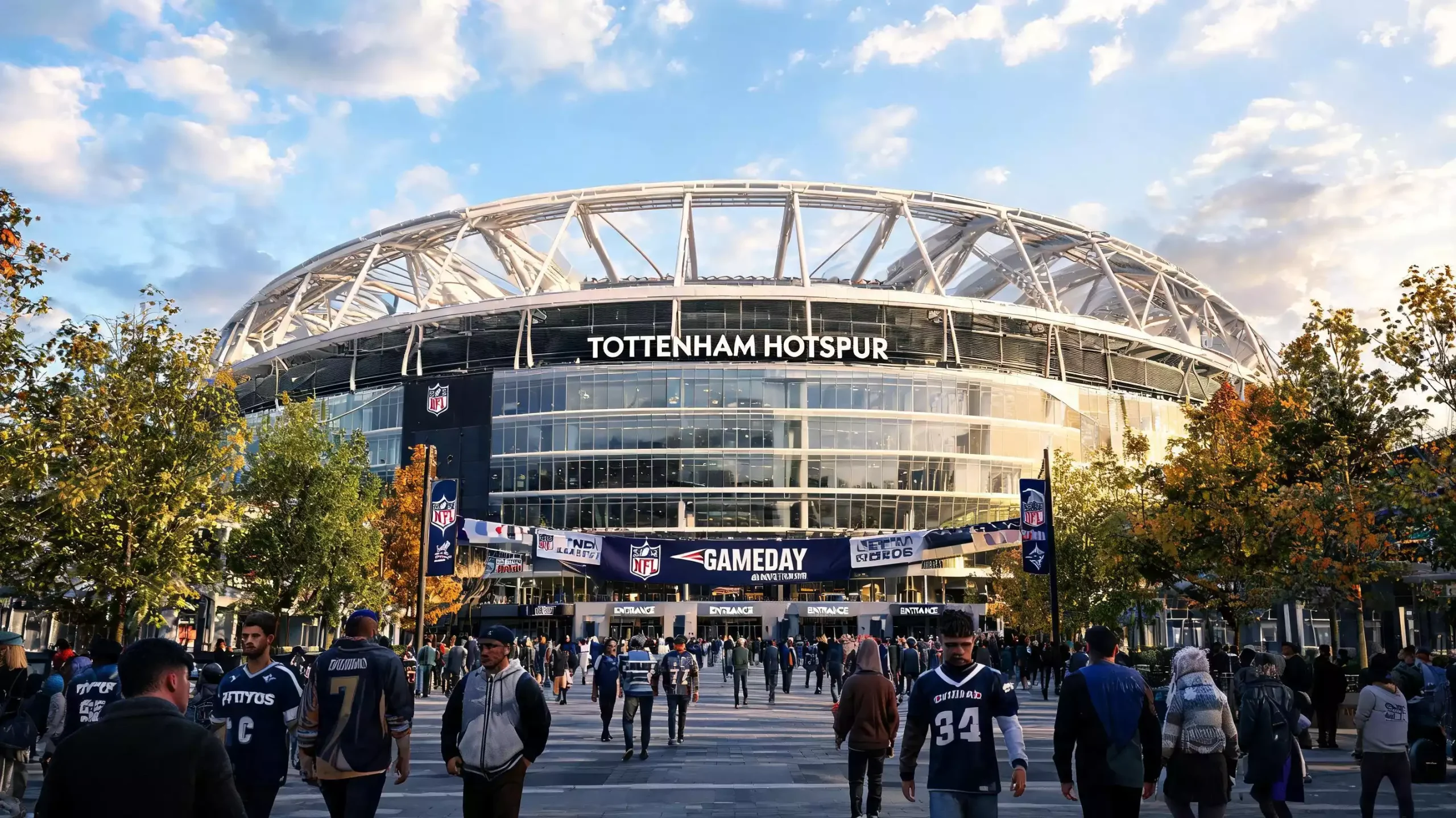
More than six million people watched the London NFL games on UK television and streaming platforms during the 2025 season. Those fixtures — played at Tottenham Hotspur Stadium and Wembley — kick off at 2:30 PM or 6:00 PM local time, making them the only regular-season NFL games that fit neatly into a standard British afternoon. They also produce unique betting angles around travel fatigue, neutral crowds, and home-team designation.
The 2025 regular season averaged 18.7 million viewers per game in the US — the second-highest figure in NFL history. That viewership translates directly into market liquidity: more eyes on games means more money flowing into the lines, which means tighter spreads and more efficient pricing. For a UK bettor, the practical implication is that early-window Sunday games tend to offer the most liquid markets with the narrowest margins, while Thursday and Monday night fixtures — with their smaller pools and higher-profile billing — sometimes produce slightly softer lines where bookmakers haven't yet absorbed all the available information.
Playoffs shrink the calendar to four rounds of single-elimination games over five weekends, culminating in the Super Bowl. Lines tighten because casual bettors flood the market and bookmakers sharpen their pricing to manage exposure. The off-season — March through August — isn't dead time. Draft betting opens in February, futures markets adjust through free agency and trades, and preseason games in August offer limited but occasionally exploitable betting opportunities. The NFL betting calendar runs twelve months a year. The question isn't whether there's action available — it's whether you're disciplined enough to bet only when the value justifies it.
Responsible Gambling and Self-Exclusion in the UK
I've had readers tell me they binged the entire NFL Sunday slate, betting every quarter total and every halftime line from 6 PM until 4 AM, then checked their accounts Monday morning and felt ill. That isn't a strategy problem. It's a boundaries problem. And the UK has more tools in place to address it than almost any other market in the world — if you know they exist and how to activate them.
GamStop is the UK's national self-exclusion scheme. Registering blocks you from all UKGC-licensed gambling sites for a chosen period — six months, one year, or five years. It covers every licensed operator simultaneously, with no option to selectively exclude from just one. Separate self-exclusion tools are also available directly through individual bookmaker accounts for more targeted pauses.
Nearly half of UK adults — 47% — participate in some form of gambling. Among those, 15% of men and 4% of women bet on sports. These aren't fringe activities. They're woven into the fabric of British leisure culture, and the risk of normalising unhealthy patterns is precisely why the UKGC has invested so heavily in consumer protection infrastructure. The regulator estimates that only around 3% of active accounts will trigger the financial vulnerability threshold, but the tools aren't designed only for the people in crisis — they're designed for everyone who wants to maintain control.
Do
- Set deposit limits at each bookmaker before the NFL season starts — you can always raise them later with a cooling-off period, but having a ceiling in place removes decision fatigue during a losing run.
- Use session timers and reality checks offered by your bookmaker. A notification at the 60-minute mark doesn't stop you from betting, but it forces a conscious decision to continue.
- Track your results in a spreadsheet or betting journal. Subjective memory of your performance is almost always more optimistic than reality.
- Treat NFL betting as entertainment with a budget, the way you'd budget for a night out or a subscription service.
Don't
- Chase losses by doubling your stake after a bad result. This is the single most destructive pattern in sports betting, and the NFL's late-night schedule makes it worse because impulsive decisions are easier to justify when you're tired.
- Borrow money to fund your betting account. If you've exhausted your designated bankroll, that's the signal to stop, not to find new money.
- Dismiss self-exclusion tools as "not for me." They exist on a spectrum from gentle nudges to hard blocks, and choosing the right level of friction is a sign of maturity, not weakness.
- Ignore changes in your mood, sleep, or relationships that correlate with your betting activity. These are data points, and a good analyst pays attention to all available data.

If you or someone you know is struggling with gambling-related harm, the National Gambling Helpline (0808 8020 133) provides confidential support. GamCare offers live chat and counselling services. These resources are free, independent, and entirely separate from any bookmaker. Using them is not an admission of failure — it's the same kind of rational risk management that this entire guide advocates.
Where to Go from Here
You now have the map — market context, bet mechanics, odds fluency, bookmaker criteria, break-even maths, regulatory awareness, and seasonal rhythm. What follows is the territory: five focused guides that take each critical area deeper than any single page can.
NFL Betting Sites UK
A data-led comparison of UKGC-licensed bookmakers — odds margins, market depth, app performance, and the criteria that actually matter. Read the full comparison.
NFL Bet Types Explained
Every NFL wager broken down with worked examples: spreads, moneylines, totals, props, teasers, same-game parlays, and how to match each type to your experience level. Explore the full guide.
Super Bowl Betting UK
The biggest single-day betting event on the planet, examined through a UK lens — pre-game odds, in-play windows, novelty markets, and the economics behind the record wagering. See the Super Bowl guide.
NFL Odds UK
Master the three odds formats, implied probability, line movement, key numbers, and how to compare pricing across UK bookmakers like a professional analyst. Go to the odds guide.
NFL Betting Strategies
The analytical methods that separate profitable punters from the rest — expected value, bankroll formulas, situational handicapping, and line shopping adapted for the UK market. Dive into strategies.
Each of those guides assumes you've read this page first. The concepts introduced here — break-even rates, odds conversion, the UK regulatory context — form the foundation that everything else builds on. If something in this guide felt unfamiliar, revisit that section before moving on. The worst thing you can do is rush past the fundamentals to get to the "advanced" material. Every costly mistake I've made in this profession traces back to a basic principle I thought I understood but didn't.
NFL Betting Online: Frequently Asked Questions
Is NFL betting legal in the UK?
NFL betting is fully legal in the UK when placed through operators licensed by the UK Gambling Commission. The Gambling Act 2005 established the framework under which all commercial gambling operates in Great Britain, and online sports betting — including American football — falls within its scope. Any bookmaker displaying a valid UKGC licence number on their website is legally permitted to offer NFL markets to UK residents. You can verify licence status on the Gambling Commission's public register. Offshore operators without a UKGC licence are not legal for UK customers, regardless of what jurisdictions they claim to be licensed in.
What are the most common types of NFL bets available to UK punters?
The five most widely available NFL bet types at UK bookmakers are moneyline (picking the outright winner), point spread (backing a team to win or lose by a certain margin, equivalent to handicap betting), totals or over/under (betting on the combined score), player and team props (wagering on specific in-game events like passing yards or touchdowns), and accumulators or parlays (combining multiple selections into a single bet). Most major UKGC-licensed bookmakers also offer same-game parlays, futures, and in-play markets during live NFL broadcasts. The depth of available markets varies by operator and by the profile of each game — a prime-time fixture typically offers hundreds of individual markets, while an early-season match between lower-profile teams may offer fewer.
How do American odds convert to fractional and decimal formats?
For positive American odds — say +150 — the fractional equivalent is the American number over 100, simplified. So +150 becomes 150/100, which simplifies to 3/2. The decimal equivalent is (150/100) + 1 = 2.50. For negative American odds — say -200 — the fractional equivalent is 100 over the American number: 100/200 simplifies to 1/2. The decimal equivalent is (100/200) + 1 = 1.50. To calculate implied probability from American odds: for negative odds, divide the absolute value by (absolute value + 100); for positive odds, divide 100 by (the number + 100). So -200 implies 200/300 = 66.7% probability, and +150 implies 100/250 = 40% probability. UK bookmakers typically let you switch display format in account settings, but understanding the conversion helps when consuming American-sourced analysis.
When is the best time to place NFL bets from the UK?
Lines for NFL games typically open on Sunday evening or Monday morning UK time for the following week's fixtures. Early-week lines reflect opening positions that haven't yet absorbed the full weight of public money, injury reports, and sharp-bettor action. By Friday evening UK time, most lines have settled toward their closing position. The optimal window depends on your strategy: if you've identified a strong position early, betting on Monday or Tuesday locks in a line before the market moves against you. If you prefer to wait for maximum information — including Thursday practice reports and Friday injury designations — betting Saturday morning UK time gives you the freshest data. For in-play betting, the early Sunday window (6:00 PM UK time kickoffs) offers the most simultaneous games and the deepest live markets. Thursday and Monday night games, which start around 1:20 AM UK time, offer single-game focus but at the cost of sleep.
What is a same-game parlay and can I place one in the UK?
A same-game parlay — often called a bet builder at UK bookmakers — combines multiple selections from a single NFL game into one bet. For example, you might combine a team to win on the moneyline, the game total to go over a set number, and a specific player to score a touchdown. All legs must win for the bet to pay out. Most major UKGC-licensed bookmakers now offer this product for NFL games, though the number of available legs and the range of combinable markets varies between platforms. The key caveat is margin: same-game parlays carry a higher embedded margin than standard accumulators because the bookmaker must account for correlation between legs. Two selections that seem independent may in fact be linked — a team winning by a large margin, for instance, correlates with higher scoring, which affects the total. Understanding these correlation dynamics is essential before building multi-leg SGPs.
How do NFL betting odds differ from football (soccer) odds?
The most visible difference is structure. Football offers three outcomes on the match result — home win, draw, away win — while the NFL effectively offers two on the moneyline because draws are extremely rare in American football (overtime rules ensure a result in almost every game). This means NFL moneyline odds don't include a draw option, and the bookmaker's margin is distributed across two outcomes rather than three. The point spread, which has no direct equivalent in standard football betting, is the NFL's dominant market — analogous to the Asian handicap in football but far more central to NFL betting culture. NFL totals markets function identically to football over/under markets. Prop betting is significantly more developed in the NFL than in football, with individual player performance metrics generating dozens of markets per game. Finally, odds formats differ by convention: UK football odds default to fractional, NFL analysis uses American odds, and you'll need to move between both fluently if you follow American sources.
Can I watch NFL games live while betting from the UK?
Multiple options exist for live NFL viewing in the UK. Sky Sports holds the primary broadcast rights and shows several games each Sunday plus all prime-time fixtures. Channel 5 broadcasts a free-to-air game on Sunday evenings. NFL Game Pass on DAZN offers every game live with on-demand replays, including the Red Zone channel that cycles between simultaneous fixtures — particularly useful for monitoring in-play bets across the Sunday slate. Super Bowl LVIII drew a peak audience of 761,000 viewers on Sky Sports, reflecting the growing UK appetite for live NFL coverage. Some UKGC-licensed bookmakers also offer in-play streaming of select NFL games directly within their platforms, though coverage varies by operator and is subject to rights agreements. Having a reliable live feed running alongside your betting interface is, in my view, a prerequisite for serious in-play wagering — reacting to odds movements without seeing the action is guesswork, not analysis.
