
NFL Betting Glossary: 60+ Terms Translated for UK Punters
 Available in US
 Available in US
Contents
The Language Barrier Between US Sportsbooks and UK Bookmakers
When I started following American handicapping content a decade ago, half the vocabulary was foreign. “Chalk” meant nothing to me. “Vig” sounded like a character from a Guy Ritchie film. “Dime line” could have been a poker term or a railway timetable reference. The language gap between US and UK sports betting isn’t trivial — it creates genuine confusion when UK punters try to apply American analytical content to their betting, and it sometimes leads to misunderstandings that cost money. A UK punter hearing “take the dog plus the hook” needs to know that means backing the underdog at a spread that includes a half-point (e.g., +3.5 rather than +3).
The UK accounts for roughly 3% of NFL fan interest worldwide by web search traffic, and the proportion of that fan base that also bets on the NFL is growing. This glossary translates the essential terms, with UK equivalents and practical context so each definition is immediately useful rather than merely academic.
See also: NFL bet types explained in full detail.
Terms A–L
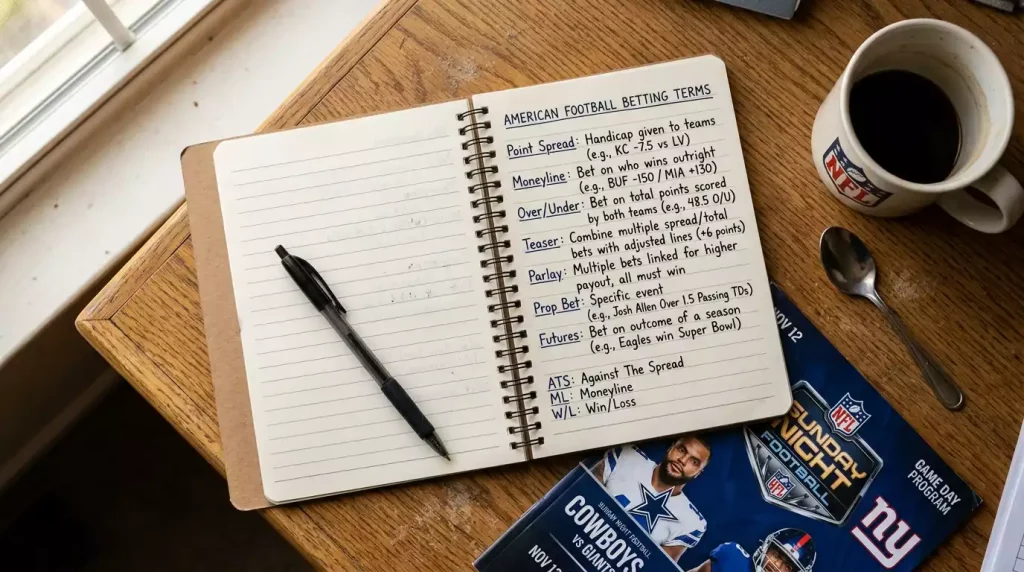
Action — any bet or wager. “I’ve got action on the late games” means bets are placed on the afternoon window. ATS (Against the Spread) — a team’s record when measured against the point spread rather than straight wins and losses. A team that is 8-4 ATS has covered the spread in 8 of 12 games. Backdoor cover — when a team scores late in a game that’s already decided to cover the spread without genuinely contesting the outcome. Bankroll — the total amount of money set aside specifically for betting. Not your savings account; your dedicated wagering fund. Beard — someone who places bets on behalf of another person, typically to disguise the true bettor’s identity. Book/bookmaker/bookie — the operator accepting bets. UK equivalent: bookmaker, operator. Buy points — paying for a more favourable spread by accepting reduced odds. Also called buying the hook when buying half a point. Chalk — the favourite in a game. “Taking the chalk” means betting on the favourite. UK equivalent: favourite or fav. Circle game — a game where the bookmaker limits betting action, typically due to uncertain injury situations or unusual circumstances. Closing line — the final odds offered before a game starts. Beating the closing line consistently is a strong indicator of long-term profitability. Cover — winning against the spread. “The Chiefs covered” means the Chiefs won by more than the spread. Dead heat — when two or more outcomes tie. Relevant for certain prop markets. Dime — a $1,000 bet in US slang. A dime line refers to a market where the difference between the favourite and underdog price is 10 cents (e.g., -110/+100). Dog/underdog — the team expected to lose. Edge — a bettor’s advantage over the bookmaker’s price. If you assess a team’s true probability as higher than the implied probability of the odds, you have an edge. Even money — odds of 1/1 (2.00 decimal, +100 American). A coin-flip price. Exotic — any bet beyond standard spread, moneyline, and totals. Props, teasers, and futures are all exotics. Exposure — the bookmaker’s potential loss on a specific outcome. Handle — the total amount of money wagered on a market or event. The NFL’s US handle for 2026 was approximately $30 billion. Handicapper — someone who analyses games and assigns ratings or predictions. UK equivalent: tipster (though handicapper implies more systematic analysis). Hold — the percentage of handle that the bookmaker retains as profit. Hook — a half-point in a spread. “Getting the hook” means receiving a half-point advantage (e.g., +3.5 instead of +3). Juice — the bookmaker’s commission on a bet. Also called the vig. UK equivalent: margin, overround. Key numbers — margins of victory that occur most frequently in NFL games, primarily 3 and 7. Lay — to bet against a team or outcome. Used more commonly in exchange betting. Limit — the maximum amount a bookmaker will accept on a single bet. Lock — a bet perceived as extremely likely to win. No bet is truly a lock, and using the term seriously is a red flag. Look-ahead lines — early odds posted for games more than a week away, typically released on Tuesday for the following week’s games.
Terms M–Z
Middle — winning both sides of a bet by landing between two different spreads. If you bet Team A -3 at one bookmaker and Team B +5 at another, and Team A wins by 4, you win both bets. Moneyline — a bet on which team will win, with no spread applied. UK equivalent: match result (though the NFL has no draw). Mover — a game where the line has moved significantly from the opening number. Nickel — a $500 bet in US slang. Off the board — a game temporarily removed from betting, usually due to breaking news. Opening line — the first odds posted for a game, typically released on Sunday evening for the following week. Over/under — a bet on whether the combined score will be above (over) or below (under) a set number. Also called the total. Parlay — a multi-leg bet where all selections must win. UK equivalent: accumulator or acca. Pick ’em — a game with no spread (0-point spread), meaning neither team is favoured. Also written pick or PK. Power rating — a numerical ranking assigned to each team by a handicapper, used to generate predicted spreads. Prop/proposition bet — a bet on a specific outcome within a game, not directly tied to the final result. Examples: player yards, touchdown scorers, coin toss. Public — casual bettors whose collective action tends to favour favourites, overs, and popular teams. Push — a bet that results in a tie against the spread, returning the stake. Also called a dead heat on the number. Reverse line movement — when the line moves against the side receiving the majority of public bets, suggesting sharp money on the other side. ROI (Return on Investment) — profit expressed as a percentage of total amount wagered. A 5% ROI means GBP 5 profit per GBP 100 staked. Runner — similar to a beard; someone who places bets on another’s behalf. Sharp — a professional or highly skilled bettor whose activity influences line movement. Also called a wise guy. Square — a casual or recreational bettor. The opposite of sharp. Steam — rapid, significant line movement caused by heavy betting action from sharp bettors. Straight bet — a single wager on one outcome. UK equivalent: single. Teaser — a multi-leg bet where the bettor adjusts the spread or total by a fixed number of points in their favour, accepting reduced odds. Tout — someone who sells betting picks or predictions. Vig/vigorish — the bookmaker’s commission, embedded in the odds. UK equivalent: margin, juice, overround. Wager — a bet. Wiseguy — a sharp, professional bettor.
US Term to UK Equivalent: A Quick Cross-Reference
Several terms describe the same concept with different words on each side of the Atlantic, and knowing the equivalences prevents confusion when consuming American content. Parlay is accumulator. Spread is handicap. Moneyline is match result (win only). Juice or vig is margin or overround. Book or sportsbook is bookmaker. Sharp is professional punter. Square is recreational punter. Chalk is favourite. Dog is underdog. Handle is turnover. Hold is gross gaming yield. Dime line has no direct UK equivalent — it describes a specific margin width that UK bookmakers don’t label explicitly.
The terminology gap is widest around staking and money slang. Americans refer to a “dime” ($1,000) and a “nickel” ($500) casually in podcasts and forums. UK punters use pounds and don’t have equivalent coded terms for specific amounts. When an American podcast says “I put a nickel on the under,” they mean $500, not 5 pence. Knowing this prevents you from either overestimating or underestimating the size of the positions being discussed, which matters when you’re evaluating whether the source’s confidence level justifies the analysis quality.
For the practical application of these terms across every NFL bet type available to UK punters, the worked examples in that guide use both US and UK terminology throughout, reinforcing the cross-reference covered here.
See also: betting online nfl — glossary of terms.
