
Responsible Gambling Tools for NFL Bettors: What’s Available and How to Use Them
 Available in US
 Available in US
Contents
Tools That Exist Precisely Because Betting Should Stay Fun
Three seasons ago, I noticed my NFL betting was bleeding into my weekday evenings. I’d start with legitimate Thursday Night Football analysis, then drift into placing bets on college games I hadn’t researched, then find myself scrolling live props at 2am on a work night. My bankroll was fine — I wasn’t losing more than I could afford — but the behaviour had shifted from deliberate to compulsive. I set a deposit limit that week. Not because I was in crisis, but because the limit forced the pause my judgment wasn’t providing on its own.
Roughly 47% of UK adults participate in some form of gambling, and 10% bet on sports online. The overwhelming majority do so without harm. But the tools designed to keep betting within healthy boundaries exist for a reason, and using them isn’t a sign of weakness — it’s the same logic as wearing a seatbelt. You don’t expect to crash, but the protection is there for the one time things go wrong. For NFL bettors specifically, the seasonal intensity of the sport — seventeen regular-season weeks, playoffs, and the Super Bowl crammed into five months — creates a rhythm that can accelerate betting frequency without conscious intent.
See also: UKGC NFL betting regulations for player protection.
Deposit Limits and Stake Caps at UK Bookmakers
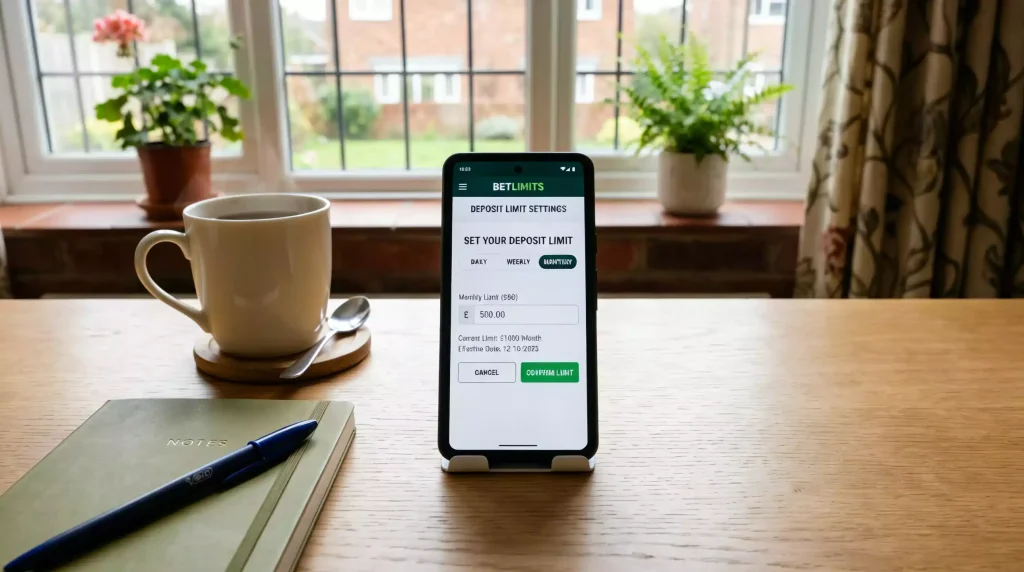
Every UKGC-licensed bookmaker is required to offer deposit limits, and setting one takes less than a minute. You choose a daily, weekly, or monthly maximum deposit amount, and once you hit it, the operator blocks further deposits until the next period resets. Reducing a limit takes effect immediately. Increasing a limit requires a cooling-off period — typically 24 to 72 hours — to prevent impulsive upward adjustments during a losing streak.
I recommend setting a weekly deposit limit rather than monthly. A monthly limit of GBP 200 sounds reasonable until you deposit GBP 180 in the first week after a bad Sunday and spend the remaining three weeks unable to bet at all. A weekly limit of GBP 50 distributes your bankroll evenly across the NFL week cycle and prevents front-loading.
Stake caps work differently from deposit limits. Some operators allow you to set a maximum stake per bet, which prevents the kind of tilt-driven large wager that can damage a bankroll in a single click. If your standard NFL bet is GBP 10 to GBP 15, setting a stake cap at GBP 25 gives you room for slightly larger positions on high-conviction plays while preventing a GBP 100 impulse bet after three consecutive losses. The 76% of UK bettors aged 18-24 who wager via mobile are particularly susceptible to impulsive staking because the phone is always within reach — stake caps add a structural barrier between impulse and action.
GamStop and Bookmaker-Level Self-Exclusion
GamStop is a free, UK-wide self-exclusion scheme that covers all UKGC-licensed online gambling operators. When you register with GamStop, every participating operator blocks your account for the period you select: six months, one year, or five years. You cannot reverse the exclusion early, and operators are legally required to enforce it.
GamStop is a significant step — it’s designed for people who feel their gambling has become harmful, not for those who simply want to take a week off. The UKGC estimates that only about 3% of active accounts reach the threshold for financial vulnerability assessment, but GamStop registrations extend well beyond that population. The scheme exists as a last-resort safety net, and it works precisely because it removes the option to override your own decision during moments of weakness.
Bookmaker-level self-exclusion is the lighter alternative. Individual operators offer their own exclusion periods — often one week, one month, three months, or six months — that apply only to that specific platform. If you find that one bookmaker’s app is the one you default to during impulsive moments, excluding yourself from that single operator while maintaining access to others can break the habit loop without cutting off all NFL betting.
A practical approach for the NFL off-season: consider a bookmaker-level exclusion from February through August. There’s no NFL to bet on (preseason doesn’t count), so the exclusion costs you nothing while resetting your relationship with the platform. I’ve done this twice, and both times I returned in September with clearer decision-making and a bankroll that hadn’t been nibbled away by off-season distractions.
Session Timers, Reality Checks, and Activity Statements
Session timers and reality checks are softer interventions that most UK bookmakers now offer. A session timer pops up after a set interval — typically 30, 60, or 120 minutes — reminding you how long you’ve been logged in and how much you’ve wagered during the session. A reality check includes your net position (profit or loss) for the session, which forces a moment of honest accounting.
I set mine to 60 minutes. On a Sunday with multiple NFL games, I can easily spend three or four hours moving between in-play markets, and the hourly check-in forces me to ask whether my betting is still deliberate or has drifted into activity for activity’s sake. The majority of my worst NFL bets — the ones placed without genuine analysis — came during extended sessions where I’d lost track of time and started betting to stay engaged rather than because I’d identified value.
Activity statements are monthly summaries showing your deposits, withdrawals, stakes, returns, and net position. UKGC-licensed operators must make these available, and I recommend reviewing yours at the end of each NFL month. The statement tells you what your gut won’t: whether your bankroll is growing, shrinking, or treading water. If you’re consistently net negative across three or more months, the statement provides the data you need to reassess your approach — whether that means adjusting your strategy, reducing your stakes, or taking a break.
For the regulatory context behind why these tools exist and how the UKGC enforces their availability, the UKGC regulation guide covers affordability checks, compliance actions, and the broader framework shaping the UK betting landscape.
Building Tools Into Your NFL Routine
The mistake most punters make is treating responsible gambling tools as emergency measures rather than routine infrastructure. I set my deposit limit, stake cap, and session timer before the NFL season starts, just as I’d set my bankroll allocation and staking plan. They’re part of the operating system, not the fire extinguisher.
A practical starting checklist: set a weekly deposit limit at the amount you’d be genuinely comfortable losing every week for seventeen weeks. Set a stake cap at roughly 2.5 times your standard bet size. Set a session timer at 60 minutes. Review your activity statement at the end of each month. These four steps take ten minutes to implement and run passively for the entire season. They don’t constrain a disciplined bettor — they protect you from the version of yourself who shows up after a bad Sunday, short on sleep, reaching for the phone at 1am because Monday Night Football is on and the live props are open.
See also: betting online nfl — responsible gambling.
