
NFL Live Betting in the UK: In-Play Markets, Timing, and Tactics
 Available in US
 Available in US
Contents
Why In-Play Is Now the Dominant Way to Bet NFL
Three years ago, I placed roughly 80% of my NFL bets before kickoff and treated in-play as an afterthought — the occasional live moneyline when a favourite fell behind early. Today, those numbers have flipped. In-play wagering now accounts for 62.35% of all online sports betting revenue globally, growing at a compound annual rate above 13%, and my own betting pattern mirrors that shift almost exactly. The reason is simple: live betting lets you react to information that pre-game markets can’t price.
A starting quarterback limps off the field after the first drive. The backup, graded 38.2 by PFF, jogs on. Pre-game, the spread was set at 3.5. The live line adjusts to 7 within two minutes — but not always fast enough. Weather shifts mid-game, a key defender leaves with a hamstring injury, or a team’s offensive coordinator abandons the run after two failed series. These are real-time variables that create pricing gaps, and UK punters who watch games live have a window to exploit them before the algorithms catch up.
The UK sports betting market generates approximately GBP 2.48 billion in annual gross gambling yield, and an increasing share of that comes from in-play activity. NFL, with its stop-start structure and frequent breaks in action, is arguably the sport best suited to live betting. Every play stoppage gives bookmakers time to recalculate — but it also gives you time to think.
See also: NFL cash out strategy to lock in profits during live games.
NFL Live Markets at UK Bookmakers
Not all live markets are created equal, and not every UK bookmaker offers the same depth. The core in-play markets you’ll find at most UKGC-licensed operators include live moneyline, live spread, live totals (over/under), next scoring play, and drive result. The larger operators go further, offering live player props — next completion, next rushing attempt, next touchdown scorer — that update after every snap.
The spread is where I spend most of my in-play time. NFL spreads move aggressively during games because scoring is chunky: a single touchdown swings the line by 6 to 7 points. If you’ve identified a team whose first-quarter performance doesn’t reflect their underlying quality — say they fumbled on the opening drive and gave up a short-field touchdown — the live spread overreacts. That 3-point favourite is now a 4-point underdog, and the fundamentals haven’t changed. The market corrects to the score, not the quality of play, and that creates value.
Live totals are the second richest market. Bookmakers adjust the game total after each score, but they also factor in pace of play and time remaining. A game sitting at 7-0 midway through the first quarter might see its total drop from 47.5 to 43.5. If both offences moved the ball effectively on their opening possessions and the score is low only because of a missed field goal and a red-zone fumble, that adjusted total can be too low. Watching the game — rather than just tracking the score — is what separates profitable in-play punters from everyone else.
Optimal In-Play Timing: Half-Time, Two-Minute Warning, and Momentum Shifts
Timing is everything in live NFL betting, and I’ve learned — through expensive mistakes — that certain windows offer consistently better value than others.
Half-time is the single best in-play window. Bookmakers reset their lines based on first-half performance, but they often overcorrect toward the team that dominated the first half. NFL games are famously volatile between halves: coaching adjustments, defensive scheme changes, and fatigue patterns all shift dramatically. I look for teams that trailed at half-time but controlled possession, moved the ball between the 20s, and failed to convert in the red zone. Those teams typically see inflated second-half spreads because the scoreboard tells a story the stats contradict.
The two-minute warning at the end of each half is another undervalued window. It functions as a forced time-out, and the market often misprices the probability of a scoring drive in the final two minutes. Teams with elite two-minute offences — fast tempo, strong passing EPA in hurry-up situations — get the same generic live odds as teams that struggle in no-huddle scenarios. If you’ve done the homework on situational efficiency, the two-minute warning is where that preparation pays off.
Momentum shifts after turnovers create the most dramatic live-odds movements, but they’re also the trickiest to exploit. The market swings hard and fast after an interception or fumble. My rule: wait 60 seconds after a turnover before placing any bet. The initial line movement overshoots about 70% of the time, and the correction happens within the next two plays. Patience in those moments has saved me more units than any single analytical insight.
Watching and Betting Live: UK Broadcast Options
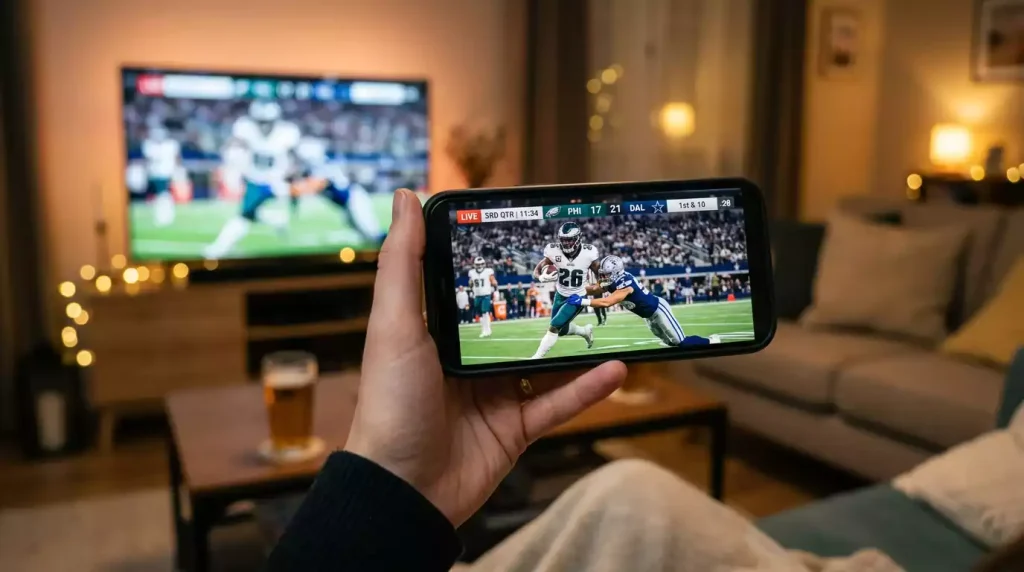
You can’t bet in-play effectively without watching the game, and watching NFL in the UK has never been easier — though it still requires planning. Sky Sports holds the primary broadcast rights, showing at least five live games per week during the regular season, including every Sunday night and Monday night fixture. Channel 5 broadcasts a free-to-air game on Saturday nights during the season’s final weeks and through the playoffs. More than 6 million people tuned into the London NFL games in the 2026 season across TV and streaming, which tells you the infrastructure for live viewing is well established.
NFL Game Pass on DAZN remains the most comprehensive option for a punter who wants access to every game. The subscription costs more than a single month of Sky Sports, but it covers all 272 regular-season games plus playoffs and the Super Bowl, with no blackouts. For in-play betting purposes, the slight streaming delay — usually 20 to 40 seconds behind real time — matters. Bookmakers price their live odds off the live TV feed, so a punter watching on a delayed stream is trading against stale information. If you’re serious about in-play, pairing a Sky Sports live broadcast with your betting app eliminates that lag.
Some UK bookmakers offer their own live streams of NFL games for customers with a funded account or a placed bet. The quality and availability vary, but the advantage is that the stream and the betting interface sit on the same platform, reducing friction. For cash-out decisions during live play, having the stream and the bet slip on one screen is a genuine practical edge.
Making Late-Night In-Play Work From This Time Zone
The reality of NFL live betting from the UK is that most games kick off in the evening or late at night. The Sunday early window starts at 6pm BST, the late window at 9:25pm, and Sunday Night Football at 1:20am Monday morning. Monday Night Football kicks off at 1:15am Tuesday. Betting in-play at 2am on a work night demands discipline — both in your staking and in knowing when to stop watching. I set a firm unit limit for each live session and close the app once I’ve hit it, regardless of how the games are going. Sleep-deprived betting is the fastest route to a blown bankroll, and the NFL schedule makes that temptation uniquely sharp for UK punters.
The stop-start rhythm of American football, the depth of live markets at UK bookmakers, and the quality of broadcast access all make NFL one of the best sports for in-play wagering from Britain. The edge comes from watching closely, timing your entries around half-time and the two-minute warning, and having the discipline to wait when the market overreacts. The data supports the shift toward live betting. The question is whether you’ll use that shift to your advantage or let it use you.
See also: betting online nfl — live betting.
