
NFL Odds Conversion: Formulas and Tables for American, Fractional, and Decimal
 Available in US
 Available in US
Contents
Three Formats, One Probability — Why Conversion Matters
The first time I tried to follow an American handicapping podcast while cross-referencing my UK bookmaker’s odds, I nearly gave up. The podcast said -110. My bookmaker showed 10/11. The betting exchange listed 1.91. All three numbers described the same price, and I couldn’t connect them. That frustration drove me to learn the conversion formulas properly, and once I did, the transatlantic gap between US NFL analysis and UK bookmaker pricing collapsed overnight. I could suddenly use American content to inform British bets without any translation delay.
UK punters who bet on the NFL operate in a uniquely multilingual odds environment. The UK sports betting market generates approximately GBP 2.48 billion in annual gross gambling yield, and the vast majority of that uses fractional odds as the default display. But NFL content — podcasts, analytics sites, tipster services, social media — overwhelmingly uses American odds. The ability to convert fluently between formats isn’t a nice-to-have skill; it’s the bridge between the information ecosystem and the platform where you place your bets.
See also: NFL odds in the UK with current lines and markets.
The Conversion Formulas with Worked Examples
There are three formats, and each can be converted to the others through simple arithmetic. I’ll work through each direction with real NFL numbers.
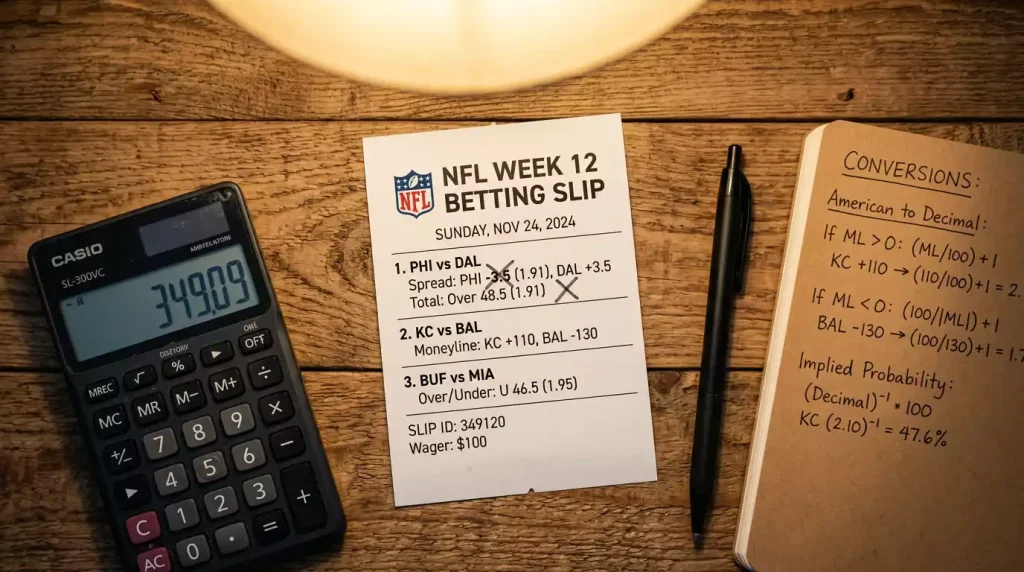
American to decimal is the conversion UK punters need most frequently, because the analytical content is American and the bookmaker is British (showing decimal or fractional). For negative American odds (favourites), the formula is: Decimal = 1 + (100 / absolute value of the American odds). A line of -150 becomes 1 + (100/150) = 1.667. For positive American odds (underdogs), the formula is: Decimal = 1 + (American odds / 100). A line of +200 becomes 1 + (200/100) = 3.00.
Decimal to fractional is straightforward: subtract 1 from the decimal odds, then express as a fraction. Decimal 1.667 becomes 0.667, which is 2/3. Decimal 3.00 becomes 2/1. Some results produce awkward fractions — decimal 1.91 becomes 0.91, which is 91/100 or approximately 10/11 in the standard fractional shorthand UK bookmakers prefer.
American to fractional combines the two steps above. -110 becomes decimal 1.909, then fractional 10/11. +150 becomes decimal 2.50, then fractional 3/2. +350 becomes decimal 4.50, then fractional 7/2.
Going the other direction — fractional to American — helps when you want to compare a UK bookmaker’s price to a US reference. If the fractional odds are less than 1/1 (evens), the selection is the favourite: American = -(100 / fractional odds expressed as a decimal). So 4/6 (which is 0.667) becomes -(100/0.667) = -150. If the fractional odds are greater than 1/1, the selection is the underdog: American = fractional odds as a decimal x 100. So 5/2 (which is 2.5) becomes +250.
I keep a conversion calculator bookmarked on my phone, but I’ve found that doing the maths manually a few dozen times builds the intuition to estimate conversions instantly. After a few months, you’ll hear “-130” and instinctively know it’s roughly 10/13 or 1.77 decimal without reaching for the calculator. That fluency matters when you’re listening to a US podcast during your commute and want to note down a value opportunity to check against UK odds later.
Quick Reference: Common NFL Odds Across All Three Formats
These are the odds you’ll encounter most frequently in NFL betting. I’ve arranged them from heavy favourite to heavy underdog, covering the range that represents 90% of standard NFL markets.
American -300, decimal 1.33, fractional 1/3 — a heavy favourite, typically seen on moneylines for teams expected to win comfortably. American -200, decimal 1.50, fractional 1/2 — a solid favourite, common on moneylines for teams favoured by a touchdown or more. American -150, decimal 1.67, fractional 2/3 — a moderate favourite. American -130, decimal 1.77, fractional 10/13 — a slight favourite, often seen on totals and adjusted spreads. American -110, decimal 1.91, fractional 10/11 — the standard “vig” price on both sides of a spread or total. This is the number you’ll see most often in NFL betting, and committing this single conversion to memory saves time every week. American +100, decimal 2.00, fractional 1/1 (evens) — a true coin-flip price. American +110, decimal 2.10, fractional 11/10 — the other side of a standard vig-priced market. American +150, decimal 2.50, fractional 3/2 — a moderate underdog. American +200, decimal 3.00, fractional 2/1 — a clear underdog. American +300, decimal 4.00, fractional 3/1 — a significant underdog, common on moneylines for teams expected to lose by double digits. American +500, decimal 6.00, fractional 5/1 — a substantial underdog, typical for teams with little expected chance of winning outright.
Calculating the Vig from Any Format
The vigorish — the bookmaker’s built-in margin — is the tax you pay on every NFL bet, and calculating it from any odds format tells you exactly how much the bookmaker is charging for the privilege of wagering.
The formula uses implied probability. First, convert both sides of a market to implied probability. For the standard NFL spread priced at -110/-110: implied probability of side A = 110/(110+100) = 52.38%. Implied probability of side B = 110/(110+100) = 52.38%. Total implied probability = 104.76%. The vig is the amount by which total implied probability exceeds 100%, which in this case is 4.76%. That 4.76% is the bookmaker’s margin on the market.
For a lopsided market — say -200/+170 — the calculation changes. Side A implied probability = 200/(200+100) = 66.67%. Side B implied probability = 100/(170+100) = 37.04%. Total = 103.71%. The vig here is 3.71%, which is actually lower than the standard spread vig. This is useful information: it tells you the bookmaker is pricing this specific market more tightly, which means less value is being extracted from your bet.
The break-even win rate for any bet is its implied probability after removing the vig. For -110 on both sides, the true break-even is 52.38% — you need to win more than 52.38% of your bets at those odds to show a long-term profit. That number is the single most important threshold in NFL betting, and understanding how it’s derived from the odds format you’re reading makes the concept tangible rather than abstract.
For a deeper exploration of how these odds calculations feed into practical value identification at UK bookmakers — including line movement analysis, futures odds, and cross-bookmaker comparison — the conversion fluency covered here is the foundation those techniques build upon.
See also: betting online nfl — odds conversion.
