
NFL Odds in the UK: Read, Convert, and Compare Like an Analyst
 Available in US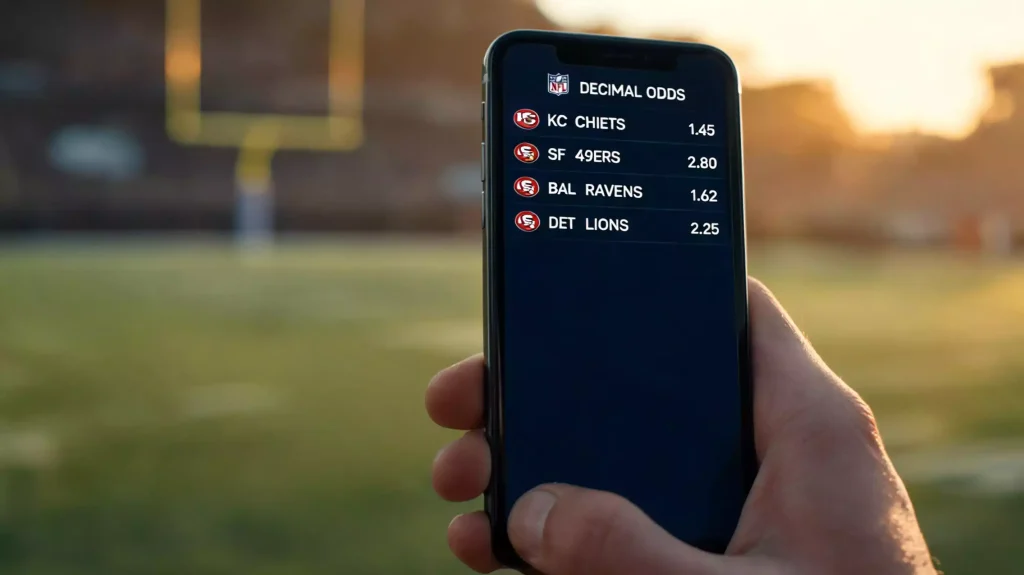
Contents
Why UK Punters Need to Think in Three Odds Formats
I once lost a bet I thought I had won because I misread American odds. The line showed +150, which I mentally registered as “1.50 decimal” — a heavy favourite. In reality, +150 in American format means an underdog returning 2.50 in decimal or 3/2 in fractional. I had the direction of the bet completely backwards. That mistake cost me forty pounds and a lesson I have never needed to repeat: if you are a UK punter betting on American football, you need to be fluent in all three odds formats, not just the one your bookmaker defaults to.
The UK sports betting market — generating roughly 2.48 billion pounds in annual gross gambling yield — operates primarily in fractional and decimal odds. American odds, expressed as positive or negative three-digit numbers, are the native language of NFL betting analysis. Every piece of American handicapping content, every sharp line movement alert, every podcast breakdown quotes odds in American format. If you cannot convert those numbers in your head within a few seconds, you are operating with a translation delay that costs you speed, accuracy, and occasionally money.
This guide is not a glossary. It is a working manual for reading, converting, and comparing NFL odds as a UK-based bettor. By the end, you will understand how bookmakers build their margin into the odds, why NFL lines move before kickoff, and how to spot the difference between a genuine value bet and a mispriced line that only looks attractive because you misread the format.
See also: NFL odds conversion between decimal, fractional and American formats.
American to Fractional to Decimal: Step-by-Step Conversion
The first time I sat down to explain odds conversion to a friend who wanted to bet on a Monday Night Football game, I drew it on the back of a napkin. Three columns, same bet, three numbers that all mean the same thing. Once you see the relationship, it clicks — and once it clicks, you never need to look it up again.
American odds come in two flavours. Negative numbers indicate the favourite: -110 means you must wager 110 units to win 100 units of profit. Positive numbers indicate the underdog: +200 means a 100-unit wager returns 200 units of profit. The reference point is always 100, which is arbitrary but consistent.
To convert negative American odds to decimal: divide 100 by the absolute value of the American odds, then add 1. So -110 becomes 100 / 110 = 0.909, plus 1 = 1.909. Round to 1.91. To convert positive American odds to decimal: divide the American odds by 100, then add 1. So +200 becomes 200 / 100 = 2.00, plus 1 = 3.00.
To convert decimal odds to fractional: subtract 1, then express as a fraction. Decimal 1.91 becomes 0.91, which is approximately 10/11. Decimal 3.00 becomes 2.00, which is 2/1. Some conversions are not clean fractions — 1.91 is technically 91/100, but UK bookmakers round to the nearest familiar fraction, so you will see 10/11 or sometimes 5/6. This rounding introduces a tiny additional margin that most punters never notice.
The conversion that matters most for practical NFL betting is American to decimal, because decimal odds let you calculate your return instantly: stake multiplied by decimal odds equals total return. A 50-pound bet at 1.91 returns 95.50 pounds, of which 45.50 is profit. A 50-pound bet at 3.00 returns 150 pounds, of which 100 is profit. That directness is why I recommend every UK NFL bettor set their bookmaker account to display decimal odds, regardless of personal preference. Fractional odds are tradition. Decimal odds are arithmetic.
Here is a quick reference for the most common NFL odds you will encounter. The standard spread price of -110 American equals 1.91 decimal equals 10/11 fractional. A slight favourite at -150 American equals 1.67 decimal equals 2/3 fractional. A moderate underdog at +150 American equals 2.50 decimal equals 3/2 fractional. A heavy underdog at +300 American equals 4.00 decimal equals 3/1 fractional. Memorise these four benchmarks and you can estimate anything in between without a calculator.
Implied Probability and the Bookmaker’s Cut
Every set of odds is a probability estimate wearing a disguise. Strip the disguise off and you see what the bookmaker actually thinks will happen — plus the margin they have baked in for profit. Learning to read implied probability is the single most important analytical skill in NFL betting, and it takes about five minutes to learn.
The formula is straightforward. For decimal odds, implied probability equals 1 divided by the decimal odds, multiplied by 100. Odds of 1.91 imply a probability of 52.36%. Odds of 3.00 imply a probability of 33.33%. For a standard NFL spread where both sides are priced at 1.91, the implied probabilities sum to 104.72%. That extra 4.72% above 100 is the overround — the bookmaker’s margin. In a perfectly fair market, both sides would be 50% and sum to 100%. The overround is the tax you pay for the privilege of placing the bet.
Mike Tierney, an NFL expert at SportsLine, has noted that sportsbooks do not always think alike with setting odds, and the difference with a key threshold line can be significant. That observation becomes actionable when you compare implied probabilities across bookmakers. If one operator prices the favourite at 1.87 (implied 53.48%) and another prices the same side at 1.95 (implied 51.28%), the second operator is effectively saying the favourite is less likely to cover — or, more precisely, is taking a smaller margin on that side. Either way, the punter who shops gets 2.2 percentage points of additional value.
The break-even implied probability for standard -110 pricing is 52.38%. This is the number every NFL bettor should have tattooed on their forearm, metaphorically speaking. It means that at standard odds, you need to win 52.38 out of every 100 bets just to return your starting bankroll. Anything above that is profit. Anything below is a slow bleed. When someone tells you they win “about half” their NFL bets, they are losing money. The margin between 50% and 52.38% is where the bookmaker lives, and it is where most casual bettors’ bankrolls go to die.
How and Why NFL Lines Move Before Kickoff
Last season, I watched a Thursday Night Football spread move from -3 to -1.5 in the space of forty minutes. No injury report had dropped. No weather update. Nothing on social media. The line just moved — and if you understood why, you had information that 90% of casual bettors missed. Lines move because money talks, and in the NFL, the loudest money belongs to the sharps.
Sharp bettors — professional or semi-professional handicappers who consistently beat closing lines — place large wagers early in the week when the market is still forming. Bookmakers track these accounts individually. When a known sharp account takes a position, the operator adjusts the line not because the sharp’s money changes the risk balance, but because the sharp’s opinion changes the operator’s assessment of the true probability. Sharp money is information. Public money — the volume of smaller bets from recreational accounts — also moves lines, but typically later in the week and with less impact per pound wagered.
For UK punters, the timing creates a practical problem. NFL lines open on Sunday evening or Monday morning UK time for the following week’s games. Sharp action in the US happens primarily Monday through Wednesday, which means the biggest line movements occur during UK working hours. By the time you check your bookmaker on Thursday evening, the early-week value has already been priced out. If you want to bet into opening lines, you need to be checking Sunday night and Monday morning — which means competing directly with the sharpest segment of the US market.
Reverse line movement is worth understanding. It happens when the majority of bets are on one side, but the line moves in the opposite direction. If 75% of public bets are on Team A -3, but the spread moves to Team A -2.5, the bookmaker is telling you that the 25% of money on the other side carries more weight. That is sharp money outweighing public volume. Reverse line movement is not a guaranteed indicator, but it is one of the few publicly visible signals of where professional money is landing.
Why Certain NFL Spreads Appear More Often
In the NFL, the number 3 is not just a number. It is the margin of victory in roughly 15% of all games — the single most common final margin in professional American football, because a field goal is worth exactly three points. The number 7 is next, representing a touchdown plus the extra point conversion. Together, 3 and 7 account for approximately a quarter of all NFL outcomes. These are the “key numbers” that every serious NFL bettor needs to understand, because they distort the relationship between a spread and its true probability in ways that standard odds do not capture.
Here is why it matters. The difference between -2.5 and -3.5 is not a single point — it is the entire 15% cluster of games that land exactly on 3. A team favoured at -2.5 covers if they win by 3 or more. A team favoured at -3.5 must win by 4 or more, which means every game decided by a field goal is a loss against the spread. That one-point difference in the spread changes the cover probability by roughly 7-8 percentage points, which is enormous. By contrast, moving from -4.5 to -5.5 crosses no key number and changes cover probability by only 2-3 percentage points.
NFL favourites win outright approximately 66% of the time, but covering the spread is a different proposition entirely. The gap between winning and covering is where the bookmaker’s pricing skill lives. When you see a line sitting at exactly -3, the bookmaker is pricing a knife-edge outcome. At -3 with standard -110 pricing on both sides, a substantial number of those bets will push — meaning neither side wins or loses. Some UK bookmakers handle pushes differently: a few void the bet, others treat it as a loss on one side. Check your operator’s push rules before betting any spread that lands on a key number.
The practical takeaway: if you are shopping between two bookmakers and one offers -2.5 while the other offers -3.5, the difference is not cosmetic. Buy through key numbers when you can, and be suspicious of any spread priced at exactly 3 or 7 — those lines carry hidden volatility that the odds alone do not communicate.
NFL Futures Odds: Season-Long and Weekly Markets
Every February, within hours of the Super Bowl final whistle, bookmakers post next season’s Super Bowl winner odds. I placed a futures bet on a divisional winner in March once, at 14/1, and watched the price shorten to 4/1 by September. That is the allure of futures — you are buying a probability estimate before the market has fully formed, and if your assessment is better than the bookmaker’s early pricing, you lock in value that evaporates over time.
NFL futures markets for UK punters typically include Super Bowl winner, conference winner, division winner, regular season win totals, and MVP. The Super Bowl winner market is the most liquid and the most popular, but it also carries the largest overround. A market with 32 teams will have implied probabilities summing to 130-150%, meaning the bookmaker is taking 30-50% margin across the field. Individual team prices look generous in isolation, but the collective margin is steep.
Win totals are a different beast. Bookmakers set a line — say 9.5 wins for a team — and you bet over or under. The pricing is typically -110 on both sides, similar to a game spread. Win totals are among the sharpest markets in NFL betting because they attract sophisticated modellers who build season-long projections. The upside for a well-informed UK punter is that win totals are less affected by public bias than Super Bowl futures, where casual bettors pile onto big-name franchises and distort the prices.
Weekly futures — markets posted for the following week’s games before final lines are set — offer a middle ground. They give you early access to lines before the full weight of sharp action has landed, but with less capital lock-up than season-long futures. The risk is that injury news or other developments between your bet and kickoff can dramatically change the picture. I treat weekly futures as a tool for specific situations: when I have a strong opinion formed early in the week and want to beat the line movement, not as a regular strategy.
Comparing NFL Odds Across UK Bookmakers
I keep three bookmaker apps on my phone during NFL season, and I check all three before placing any bet over twenty pounds. The reason is not loyalty management or bonus hunting — it is arithmetic. The difference between 1.87 and 1.95 on the same outcome, compounded across a full season of bets, is the difference between a losing year and a profitable one. In a market generating 2.48 billion pounds in annual gross gambling yield, even small pricing differences create real money at scale.
UK operators price NFL games differently for structural reasons. Some bookmakers use US-sourced odds feeds and convert them to decimal or fractional format, adding their own margin on top. Others have in-house NFL traders who set independent lines. A third group uses a hybrid model, sourcing opening lines from US feeds and adjusting based on their own customer flow. The result is that the same game can show meaningfully different odds across three or four UK operators, particularly on player props and alternative spreads where the market is thinner and less efficient.
The timing of odds availability matters too. Some UK bookmakers post NFL lines on Sunday evening for the following week. Others wait until Tuesday or Wednesday. Early lines carry more risk for the bookmaker — and more potential value for the punter — because the market has not yet been shaped by sharp money. If your preferred operator posts lines late, you are seeing prices that have already been corrected by professional action at other bookmakers. That is a structural disadvantage, and it is worth switching your primary account to an operator that posts earlier if NFL is your main betting interest. For a broader look at how UK operators compare on criteria beyond odds, the data-led comparison of NFL betting sites breaks down the full picture.
Ninety-five percent of UK gambling now happens online and from home, which makes odds comparison trivially easy in practice. The friction is not technical — it is psychological. Most punters default to whichever bookmaker they opened their first account with, even when better prices are a thirty-second search away. Overcoming that inertia is the cheapest edge in NFL betting. It requires no analytical skill, no modelling ability, and no insider information. It just requires checking.
Understanding NFL Odds: Quick Answers
See also: betting online nfl — your complete NFL odds guide.
